
The Hidden Cost of Skipping Foundations: How Small Gaps Become Big Problems
• 2/20/2026
It usually starts small: a topic that never quite clicked, a unit that moved a little too fast, a skill that was “good enough” at the time. Months later, that small miss shows up as a big struggle. This is the hidden cost of skipping foundations - and it explains why so many learning problems seem to appear out of nowhere.
The mystery of the sudden struggle
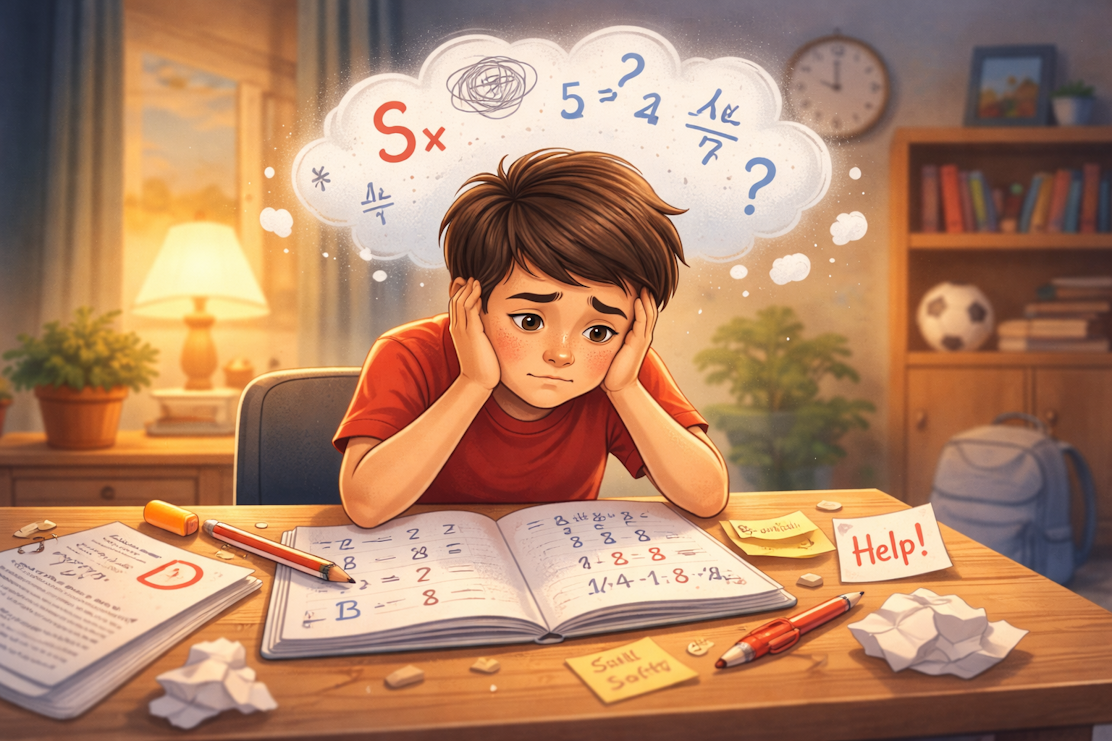
Many parents recognize this moment. Your child did fine last year. Homework wasn’t a battle. Then, seemingly overnight, school becomes harder. Grades wobble. Confidence drops. You hear things like, “I don’t get this anymore,” or “I used to be good at this.”
It’s tempting to blame the new teacher, the harder curriculum, or a dip in motivation. Sometimes those play a role. But very often, the real cause is quieter and older: a small foundational gap that’s finally being asked to carry more weight than it can handle.
Foundations matter because learning is cumulative. New skills don’t replace old ones - they stack on top of them. When one layer is thin, everything above it becomes unstable.
What “foundations” actually mean in learning
Foundations are the prerequisite skills and concepts that more advanced learning depends on. They are not just “earlier topics” on a syllabus. They are the mental building blocks that make later ideas make sense.
In math, foundations include things like:
- Understanding place value
- Fluency with basic operations
- Knowing what fractions represent
- Recognizing relationships between numbers
In reading, foundations include things like:
- Decoding words accurately
- Basic vocabulary knowledge
- Tracking meaning across sentences
- Understanding how ideas connect in a paragraph
When these pieces are solid, new learning feels like extension. When they are shaky, new learning feels like guesswork.
Why small gaps don’t stay small
A common misconception is that a small weakness stays small. In reality, gaps tend to compound.
Here’s why:
- New topics assume old skills are reliable.
- Practice shifts toward the new material, not the old gaps.
- Students use workarounds and memorization to keep up.
- Those workarounds break under more complex demands.
At first, the gap is easy to hide. A child might guess correctly, follow a pattern, or memorize steps. Performance looks “okay.” But as problems become longer, more varied, or more conceptual, the missing piece starts to matter more.
What began as a small crack turns into a fault line.
A simple analogy: building on soft ground
Imagine building a house on ground that looks firm but has a soft patch underneath one corner. At first, everything seems fine. The walls go up. The roof goes on. The house stands.
Over time, though, as more weight is added, that soft patch starts to sink. Doors stop closing properly. Cracks appear. Eventually, you can’t ignore it.
Learning works the same way. Early gaps don’t always cause immediate failure. They cause structural weakness that shows up later, when the cognitive load increases.
How skipping foundations happens (even in good schools)
Most gaps are not the result of neglect or bad teaching. They emerge naturally from how school works.
1) The class moves on before understanding is complete
Curricula have timelines. Units end. Tests happen. Even when a child is only partially comfortable, the class advances. That partial understanding is often “good enough” for now - but it becomes a weak link later.
2) Grades can hide fragile knowledge
A child can earn decent grades using memorization, pattern recognition, or short-term study strategies. Those methods can mask weak foundations until the work demands transfer and integration.
3) Practice focuses on what’s new, not what’s missing
Once a topic is “covered,” practice usually moves on. The missing pieces don’t get revisited unless someone deliberately looks for them.
4) Different learners need different amounts of time
Some students need more examples, more representations, or more repetition. If they don’t get it at the moment the class moves on, a gap forms - even if they are capable of learning the material well.
5) Life interrupts learning
Absences, school changes, stress, or illness can all create holes in instruction. The curriculum continues. The hole remains.
What compounding gaps look like in real life
Here are a few common patterns parents see:
From arithmetic to algebra
A student who never fully mastered fractions and negative numbers may survive pre-algebra by memorizing steps. In algebra, where symbols replace numbers and steps must be chosen, those gaps become major obstacles.
From decoding to comprehension
A child who reads slowly or inconsistently may still understand short passages. As texts get longer and ideas get denser, the mental effort spent decoding leaves less capacity for meaning.
From single-step to multi-step problems
A student who is shaky with basic operations may handle single-step problems. Multi-step problems, which require holding and combining several ideas, expose the weakness quickly.
In each case, the later struggle is not really about the new topic. It’s about the foundation the new topic depends on.
The emotional cost of unstable foundations
The academic cost of gaps is real - but so is the emotional cost.
When learning feels unpredictable, students start to:
- Doubt their ability
- Avoid challenging work
- Rely on memorization instead of understanding
- Assume they are “just not good” at the subject
This is especially painful because the problem is often not lack of ability. It’s a structural issue in how the knowledge is built.
Stable foundations don’t just support skills - they support confidence.
Why “just practice more” often doesn’t fix it
When a child struggles, the natural response is to add more practice at the current level. Sometimes that helps. Often, it doesn’t.
Why? Because practicing a skill that depends on a missing prerequisite is like practicing balance on a broken step. You can repeat the motion, but the structure underneath is still unstable.
In these cases, more practice can:
- Increase frustration
- Encourage guessing or shortcuts
- Strengthen the wrong habits
- Delay the real fix
Progress comes faster when you repair the foundation instead of reinforcing the cracks.
How to recognize when a foundation is the real issue
Look for these clues:
- Your child can follow steps but can’t explain why they work.
- Performance drops sharply when problems are mixed or reworded.
- Errors cluster around basic ideas (place value, signs, operations, vocabulary).
- Multi-step problems fall apart in the middle, not at the end.
- Your child often says, “I get confused,” rather than, “I made a small mistake.”
These patterns usually point to a missing or fragile prerequisite.
The right way to rebuild: go smaller before going faster
Rebuilding foundations is not about going backwards in a discouraging way. It’s about going more precise.
A good repair process usually includes:
- Diagnose the exact missing piece (not the whole topic).
- Practice it at the right level of difficulty (challenging but achievable).
- Add variation so the idea isn’t tied to one format.
- Reconnect it to the current topic so learning moves forward again.
This often feels slower for a short time - and then faster for a long time.
Why precision beats volume
Ten minutes spent fixing the right foundation can save hours of struggling later.
When learning is targeted, students:
- Make fewer random errors
- Rely less on memorization
- Transfer skills more easily
- Regain confidence more quickly
This is the opposite of the “more worksheets” approach. It’s not about doing more - it’s about doing what matters.
A short checklist for parents
If your child is struggling, try this:
- Ask them to explain their thinking, not just give answers.
- Notice where in a problem things break down.
- Look one or two steps earlier in the skill chain.
- Test the suspected foundation with a few simple variations.
- Strengthen that piece before piling on more advanced practice.
This approach turns frustration into a plan.
The long-term payoff of strong foundations
When foundations are solid, learning becomes more predictable and less stressful. New topics feel like extensions, not ambushes. Mistakes become easier to fix. Progress becomes easier to sustain.
Strong foundations don’t just support the next unit. They support the next year - and the one after that.