
Skill Maps Explained: How Learning Is Really a Network, Not a List
• 4/4/2026
Most school subjects are presented as a sequence. First this topic, then the next, then the next. It feels orderly and logical, like climbing steps on a ladder. But learning does not actually work like that. In reality, learning is much closer to a network of connected skills, where each idea depends on several others. When one piece is missing, it can affect everything built on top of it. Understanding this difference can completely change how you see your child’s progress and how you help them when they struggle.
Why learning is not a straight line
Traditional curricula are designed to move forward in a straight path. Students are introduced to a topic, practice it, and then move on. This creates the impression that once a topic is covered, it is complete. But many skills are not independent. They rely on earlier foundations that may not be visible on the surface.
For example, fractions depend on multiplication and division, division depends on understanding place value, and word problems depend on both math and reading comprehension. Even though these skills are taught in different units or even different years, they are tightly connected. When a child struggles with a new topic, the real issue is often not the new topic itself, but a missing prerequisite skill.
What are prerequisite skills?
A prerequisite skill is a skill that must be understood before another skill can be learned effectively. Think of it like building blocks. If a lower block is unstable, anything placed on top becomes harder to balance.
In learning, you cannot confidently divide fractions without understanding multiplication, you cannot solve algebra problems without strong arithmetic foundations, and you cannot understand complex reading passages without basic language skills. When a prerequisite is weak, learning feels harder, slower, and more frustrating.
The hidden problem with linear learning
Linear learning hides these dependencies. When students move from one topic to the next, there is often no check to ensure that the underlying foundations are truly solid. As a result, a child completes a unit and moves on while a small gap remains unnoticed. New topics then build on that gap, and over time it grows into a larger problem.
By the time the struggle becomes visible, it can be difficult to trace it back to the original cause. This is why parents often see situations where homework looks fine but tests are harder, the same mistakes keep repeating, and progress feels inconsistent. The issue is not effort. It is structure.
Learning as a skill map
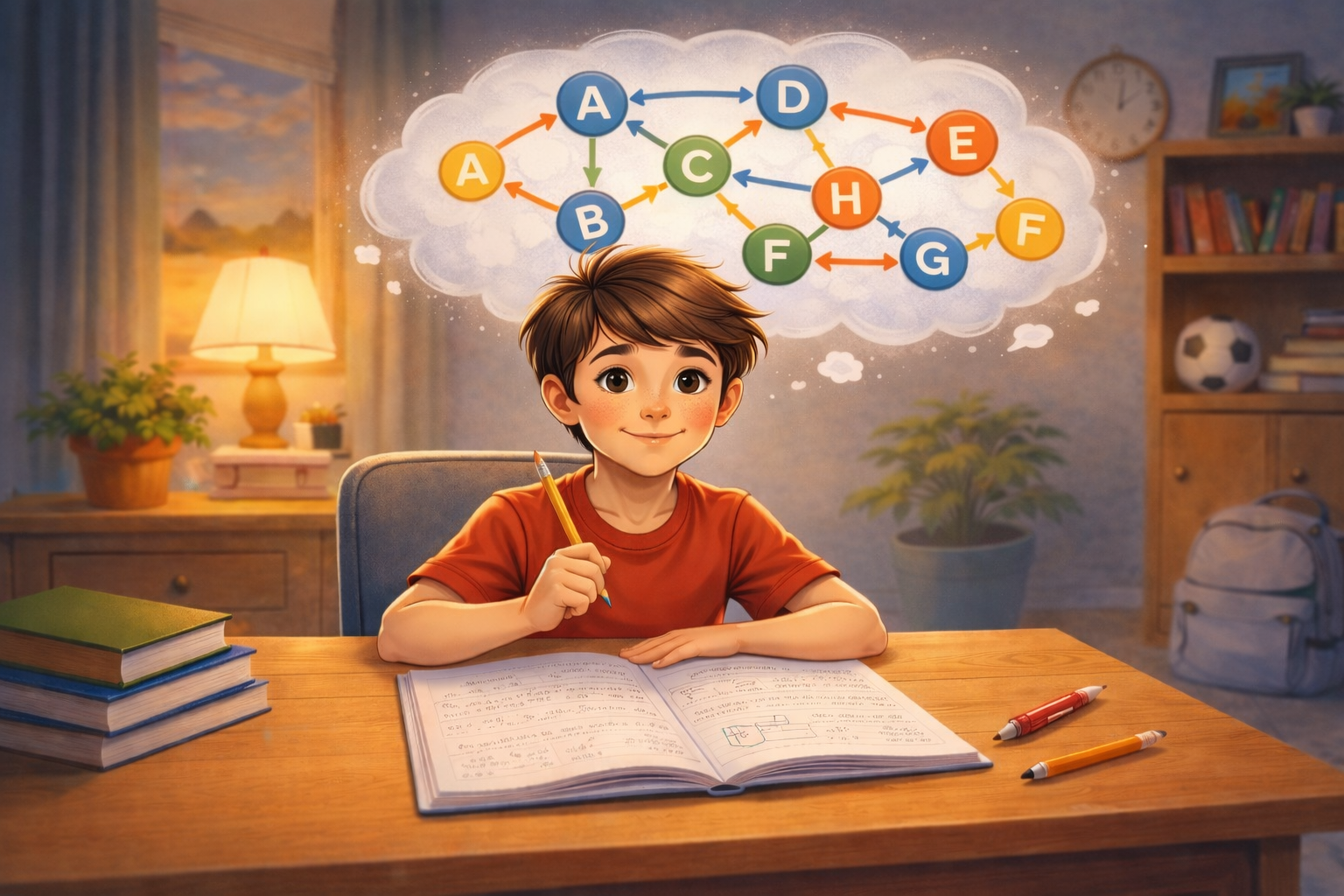
A better way to think about learning is as a skill map. Instead of a straight line, imagine a network where each node represents a skill and connections represent dependencies. Some skills support many others, while some rely on multiple foundations.
In this model, learning becomes more transparent. You can see not just what your child is working on, but what supports it underneath.
Why skill maps change everything
When learning is viewed as a network, it becomes much easier to understand struggles. Instead of asking, “Why is my child struggling with this topic?” you can ask, “Which underlying skill is causing this difficulty?”
This shift is powerful because it turns learning from guesswork into something much more precise. Instead of reviewing an entire topic, you can focus on the exact skill that needs strengthening.
A simple example
Imagine a child struggling with fractions. A traditional approach might assign more fraction worksheets. But a skill map might reveal something different. The child may understand fractions conceptually but still struggle because multiplication facts are not yet automatic.
This changes the entire approach. Instead of repeating fractions, the focus shifts to strengthening multiplication. Once that foundation improves, fractions often become much easier.
Why this matters for remediation
Remediation is often inefficient because it focuses on symptoms instead of causes. If a child struggles with a topic, they are usually given more practice on that same topic. But if the root problem is a missing prerequisite, this approach does not solve the issue.
Skill maps allow remediation to be more targeted, more efficient, and more effective. Instead of doing more work, the child does the right work.
How skill maps support long-term progress
When foundational skills are strong, learning becomes smoother. New topics connect naturally to what the child already understands, which leads to faster learning, fewer repeated mistakes, and greater confidence.
Over time, the entire learning experience improves. Instead of feeling like a series of disconnected topics, learning starts to feel coherent and manageable.
What parents can take away
You do not need to map every skill yourself to apply this idea, but it helps to think differently about learning. When your child struggles, consider whether this might be a missing foundation, whether there is an earlier skill that needs attention, and whether repeating the same topic actually addresses the problem.
These questions can lead to much more effective support.
Learning is a network, not a checklist
It is tempting to think of learning as a checklist of completed topics, but real understanding is built through connections. Each skill strengthens others, and each gap weakens the structure.
When you begin to see learning as a network, it becomes easier to understand both progress and struggle. Most importantly, it becomes clearer how to help your child move forward.