
How to Tell If Your Child Has a Learning Gap (And Where It Comes From)
• 2/20/2026
Many children work hard, complete assignments, and still fall behind in ways that are hard to explain. If your child seems to “almost get it” but keeps stumbling, you may be looking at a learning gap. The good news: gaps are common, understandable, and fixable - once you know what to look for.
The quiet problem: when effort doesn’t turn into progress
Most parents can spot obvious struggles: failing grades, missing assignments, or constant frustration. Learning gaps are trickier. They often hide behind decent homework scores, helpful teachers, or a child who is trying their best.
A learning gap is not about motivation or intelligence. It’s about a missing or fragile skill that other skills depend on. When that foundation is weak, newer topics feel confusing, even if your child keeps practicing.
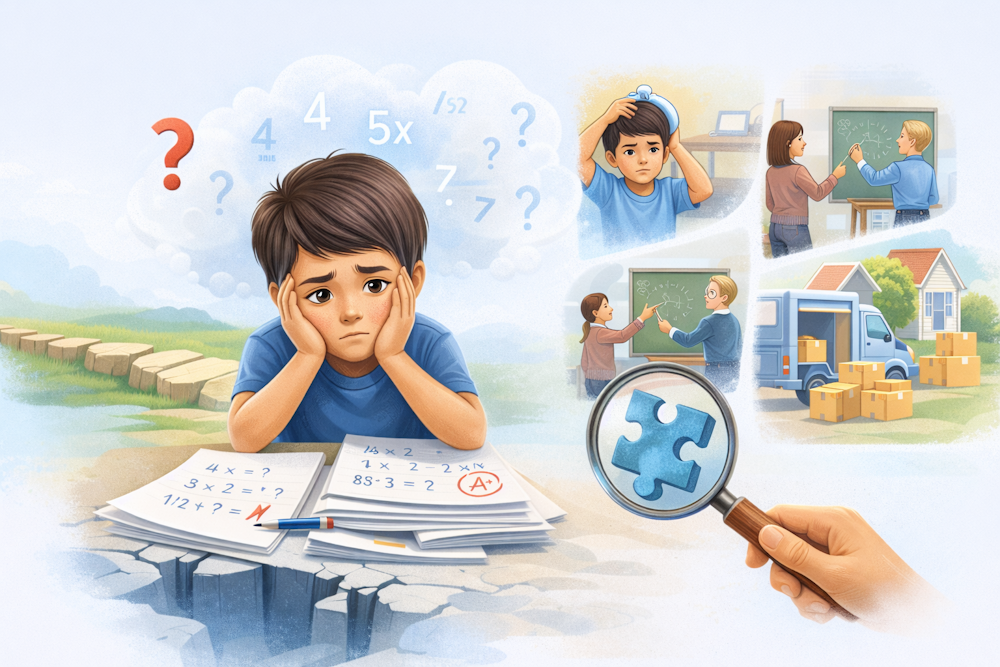
Think of learning like building a trail across rough terrain. Each skill is a stepping stone. If one stone is loose or missing, your child can still hop across for a while - but every step becomes riskier. Eventually, they trip.
What a learning gap really is
A learning gap is a specific missing piece of knowledge or skill that makes future learning harder than it needs to be.
It is usually not:
- “My child is bad at math.”
- “My child is behind in reading.”
- “My child just doesn’t try hard enough.”
It is more often something like:
- They don’t reliably understand place value, so multi-digit operations keep breaking.
- They never fully mastered multiplication facts, so fractions feel impossible.
- They can decode words, but struggle to track meaning across paragraphs.
- They learned a procedure, but not the concept underneath it.
In other words, gaps are precise, even if the symptoms look broad.
Why learning gaps are so common
Gaps don’t mean a child failed. They usually appear because of how learning actually works in real life.
1) Learning builds on itself
Most subjects - especially math and reading - are cumulative. New skills assume old skills are solid. When one piece is shaky, the next piece becomes harder, and the one after that harder still.
A small gap can stay invisible for months. Then suddenly, everything feels harder, and it looks like the child “hit a wall.”
2) Classrooms move on, even if understanding isn’t complete
Schools have schedules. Units end. New topics begin. If a child is 80% comfortable, they often move forward anyway. That 20% doesn’t disappear - it travels with them.
3) Practice can hide weak foundations
As discussed earlier, repetition can build fluency in a narrow routine. A child might look successful on homework while relying on patterns or memory, not understanding. When the topic shifts, the weakness shows up.
4) Different kids need different amounts of time
Some children need more repetition, different explanations, or more concrete examples. If they don’t get them at the right moment, a gap can form even in a supportive classroom.
5) Life happens
Illness, school changes, stress, or missed instruction can all interrupt learning. The class keeps going. The gap stays.
Common signs your child may have a learning gap
Learning gaps don’t always announce themselves clearly. Here are patterns many parents notice first:
- Inconsistent performance: Sometimes your child does fine, sometimes they struggle with the same kind of work.
- Works in familiar formats, struggles in new ones: Homework looks okay, tests or word problems do not.
- Relies on cues: They ask, “Is this a division one?” instead of recognizing what the problem is asking.
- Can’t explain their thinking: They can get an answer, but not explain how or why.
- Frequent small mistakes: Especially in multi-step work, where one weak link breaks the chain.
- Growing frustration or avoidance: Tasks that used to feel manageable now feel overwhelming.
- Needs constant reminders of basics: Skills that should be automatic keep needing refreshers.
Any one of these can happen occasionally. When several show up together, or keep repeating, a gap is a likely cause.
The difference between being “behind” and having a gap
These are not the same thing.
Being “behind” usually describes where a child is relative to a schedule. A child might be behind because:
- They started later
- They need more time
- They are learning at a different pace
A learning gap describes a missing link in the skill chain.
A child can be:
- Behind but conceptually solid (just moving slower)
- On grade level but full of hidden gaps
- Ahead in some areas and struggling in others
Grades and grade levels don’t tell you where the real gaps are. Skills do.
Where learning gaps usually come from
1) Missing prerequisites
Many skills depend on earlier ones. For example:
- Fractions depend on multiplication, division, and understanding parts of a whole.
- Algebra depends on arithmetic fluency and understanding variables.
- Reading comprehension depends on decoding, vocabulary, and working memory.
If one of these prerequisites is weak, the later topic feels confusing - even if the child is trying hard.
2) Procedural learning without conceptual understanding
Sometimes a child learns what to do without learning why it works. This can get them through worksheets, but it creates fragile knowledge. When the problem changes, the procedure no longer fits.
3) Partial understanding that never got finished
Learning is not always all-or-nothing. A child might understand 70% of a concept and still move on. That missing 30% can cause problems later, especially when the topic is used as a building block.
4) Over-reliance on memorization
Memorization has its place, but when it replaces understanding, it creates gaps that only show up under pressure or variation.
5) Cognitive overload during initial learning
If a topic was introduced when too many things were new at once, a child might have formed shaky or incomplete mental models. Those don’t always repair themselves without targeted help.
How gaps compound over time
One of the most important things to understand about learning gaps is that they rarely stay the same size.
A small gap today can become:
- A source of constant mistakes next month
- A reason to avoid certain topics next year
- A confidence issue that affects motivation
This doesn’t happen because the child is getting worse. It happens because the curriculum keeps building on top of a weak foundation.
That’s why early, precise detection matters so much more than simply adding more practice.
How to start identifying your child’s real gaps
1) Look for patterns, not single scores
One bad quiz doesn’t mean much. Repeated trouble with the same kind of thinking does.
2) Ask “what broke?” instead of “what was wrong?”
When your child makes a mistake, try to trace it back:
- Did they misunderstand the question?
- Did they choose the wrong method?
- Did they make a basic calculation error?
- Did they get lost in the middle of a multi-step process?
Each answer points to a different kind of gap.
3) Ask for explanations in simple language
“How did you know to do that?” is often more revealing than checking the final answer. If your child can’t explain their thinking at all, that’s a strong clue the understanding may be fragile.
4) Change one thing and see what happens
Take a problem your child can do and change the format slightly. If performance collapses, the skill may be tied to surface patterns instead of deeper understanding.
5) Don’t assume the gap is where the struggle shows up
If your child struggles with a topic, the real gap is often one or two steps earlier in the skill chain.
Why guessing is the enemy of progress
Without a clear picture of the gap, it’s easy to respond with:
- More worksheets
- More time
- More pressure
Sometimes that helps. Often, it just adds frustration.
Targeted learning is far more efficient than more learning. When you know exactly what’s missing, you can fix it faster and with less stress.
The encouraging truth about learning gaps
Learning gaps are not permanent labels. They are repairable breaks in the chain.
With the right diagnosis, the right level of difficulty, and the right kind of practice, most gaps can be closed - and often faster than parents expect.
What matters is shifting the question from:
“How do we get through more material?”
to:
“Which specific skill needs strengthening right now?”