
Fluency vs. Mastery: Why Speed Isn’t the Same as Understanding
• 2/20/2026
If your child can finish their work quickly but still makes surprising mistakes, you’re seeing a very common learning gap: fluency without mastery. Speed looks impressive - but it isn’t the same as understanding.
The confusing success: fast, accurate… and still struggling
Many parents have seen this pattern:
- Your child finishes homework faster than expected.
- They often get high scores on routine assignments.
- But on tests or new problem types, their performance drops.
- They say things like, “I knew it yesterday,” or “It looked different.”
This can feel baffling. If they’re fast and usually right, shouldn’t that mean they understand?
Not always.
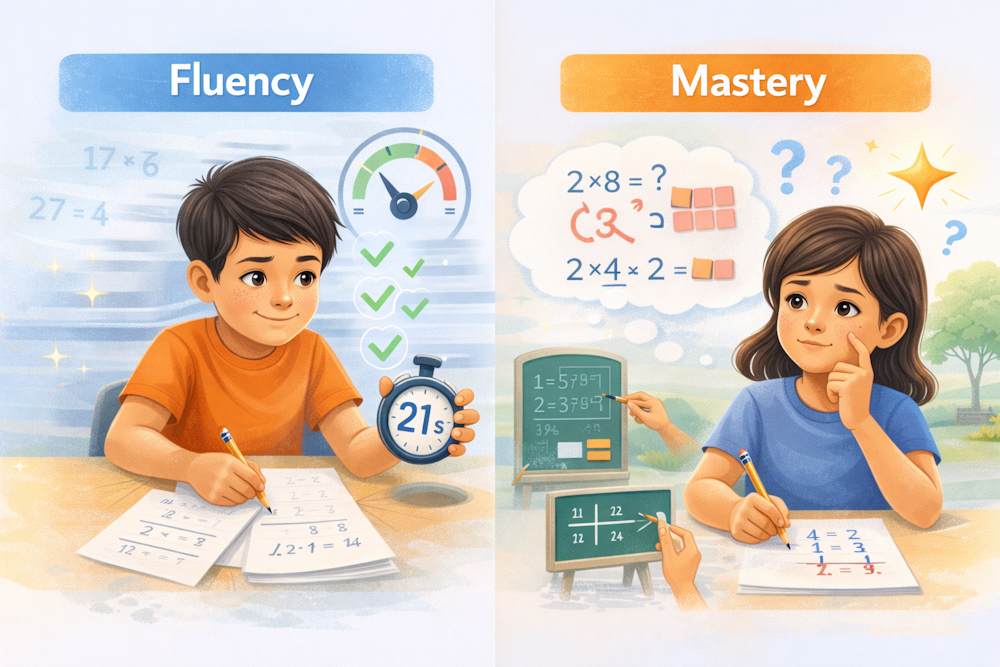
What you’re often seeing is fluency without mastery. Fluency is about speed and efficiency. Mastery is about reliability and flexibility. Both matter - but they are not the same thing.
What fluency really is (and why it’s useful)
Fluency is the ability to perform a skill quickly and smoothly. In school, this usually means:
- Recalling math facts quickly
- Reading words with little hesitation
- Applying a familiar procedure without stopping to think through every step
Fluency is valuable. It reduces mental load. It frees up attention for more complex thinking. A child who has to count on their fingers for every addition problem will struggle with multi-step word problems later.
So speed and efficiency are not the enemy. They’re an important part of learning.
The problem comes when fluency is mistaken for mastery.
What mastery adds that fluency doesn’t
Mastery means a skill is stable, flexible, and reliable. A child who has mastered a skill can:
- Use it correctly days or weeks later
- Recognize when to use it in different situations
- Apply it in new formats (not just the one they practiced)
- Explain their thinking, at least in simple terms
- Recover when a problem looks unfamiliar
In other words, mastery shows up when the surface details change.
Fluency, by contrast, often shows up only when the problem looks just like practice.
The worksheet trap: how fluency can hide fragile understanding
Many practice materials are designed to build fluency: rows of similar problems, same format, same steps, over and over. This can be useful early on - but it also teaches the brain a shortcut.
Instead of learning the underlying idea, the brain learns to recognize a pattern and execute a routine.
As long as the pattern stays the same, performance looks great. The child appears fluent. But when the pattern changes - different wording, different layout, mixed with other skills - the shortcut stops working.
That’s when parents often hear: “I don’t get it anymore,” even though the child was “doing fine” last night.
Why speed can be misleading
Speed is easy to measure. Understanding is not.
A fast answer feels reassuring. A slow, thoughtful answer can look like struggle - even when it reflects deeper thinking.
But speed mostly tells you how automatic something is, not how robust it is.
Confidence comes from reliability, not just speed
Kids gain real confidence when their skills work reliably. When they don’t have to hope the problem looks familiar. When they trust themselves to figure things out even if it looks new.
Fluency helps. But mastery is what makes learning feel solid.
If your child is fast but fragile, the solution isn’t to slow them down - it’s to deepen the learning underneath.